
Home / FAQ
FAQ
Frequently Asked Questions
Answers about plug and process load management, BERT products, savings, and how to work with us.
General
Who is BERT?
BERT (Best Energy Reduction Technologies) is a plug and process load management provider helping commercial, industrial, and institutional facilities reduce energy use at the device level. We specialize in practical control solutions for schools, local governments, building owners, and long-term commercial tenants.
What is plug and process load management?
Plug and process load (PPL) management is the intelligent monitoring and control of electrical devices that often operate outside a traditional building automation system (BAS). These include office equipment, classroom technology, charging equipment, comfort loads, and selected hardwired devices.
Is this the same as fixing "phantom load" or standby power?
Related, but broader. Phantom load and standby power describe the energy a device draws when it's off or idle. BERT addresses that and more: it also schedules equipment fully off during unoccupied hours and uses threshold logic so equipment such as projectors can finish a cool-down cycle, and temperature logic with restart safeguards, then measures and reports the result.
Where do BERT's energy savings come from?
Many devices keep using energy while idle, in standby, charging, or simply left on after a building is empty. BERT reduces this avoidable runtime through approved schedules and intelligent control strategies. The opportunity varies by equipment type, operating pattern, and facility.
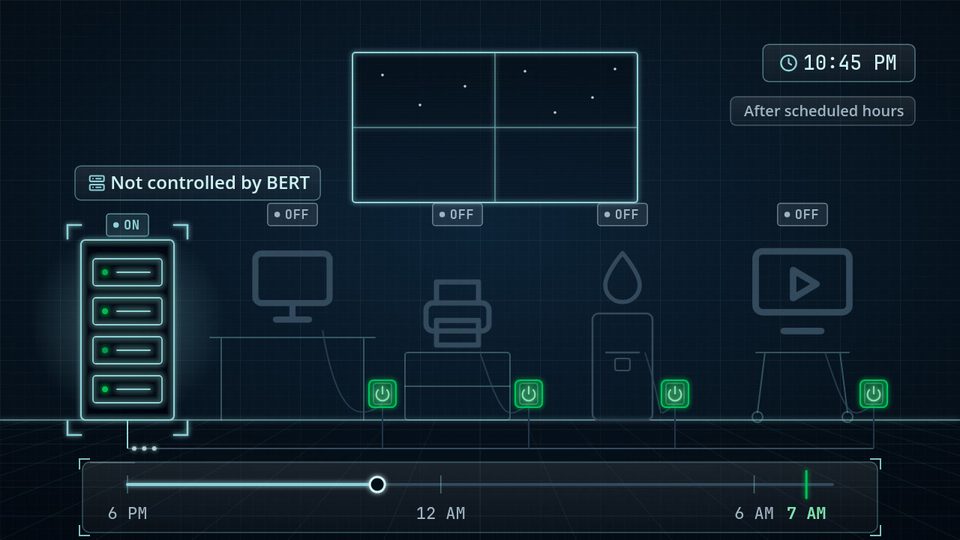 Watch: How BERT Works (0:20)
- BERT switches devices off when nobody needs them.
- Loads that must stay on are never touched.
- Power is back on before the scheduled start of the day.
- Up to 50% savings on the devices BERT controls.
What kinds of devices does BERT typically control?
Common applications include printers and copiers, displays and classroom technology, charging carts, vending and water equipment, workstations, selected comfort equipment, window AC and PTAC/PTHP units, exhaust fans, water heating, selected lighting, and many other plug-connected or hardwired loads not already being controlled.
Which devices are generally not controlled by BERT?
BERT is not normally applied to life-safety systems, servers and core network equipment, medical-support equipment, perishable or temperature-sensitive refrigeration, or other loads that must remain continuously energized. Very low-energy devices may also offer little practical savings.
Does BERT limit voltage or current to devices?
No. A BERT controller removes or restores power. When the controlled device is on, normal line power passes through to the equipment.
How is BERT different from a timer or consumer smart plug?
BERT is an enterprise energy management system, not a standalone timer. It combines commercial-grade controllers, device-level measurement, centralized scheduling, reporting, system monitoring, local operating logic, and fleet management through BERTBrain.
My devices are already smart or ENERGY STAR certified. Why do I need BERT?
Many devices have standby or schedule settings, but they're often overridden or never kept up. BERT controls them consistently, whether or not they have schedules of their own, with a facility-wide control layer that is centrally managed, measured, and adjustable.
System, Software, and Network
What are BERTBrain and the BERTBrain Gateway?
BERTBrain is the software platform used to organize, schedule, monitor, and report on BERT-controlled devices. The BERTBrain Gateway is the local system hub: it runs BERTBrain, coordinates device communications, and supports cloud-connected or approved on-premises deployments. It replaces the customer-provided PC or virtual machine older BERT systems needed.
How many gateways does a system need?
Most BERT systems need only one BERTBrain Gateway. Very large deployments may use more; BERT sizes the gateway configuration for each project.
How does BERT communicate?
BERT controllers use the organization's approved Wi-Fi network. BERT typically works with the customer's IT team to place devices on an appropriate network, often a dedicated or segmented IoT network.
Why does BERT use Wi-Fi instead of its own wireless system?
BERT controllers use your building's Wi-Fi so your IT team can see, manage and approve the connection like any other device on the network — often on a separate network just for building devices. That means no separate radio network or repeaters to install or maintain; a BERTBrain Gateway connects everything. If Wi-Fi or the internet drops, each controller keeps running its own stored schedule, and the override button still works.
What happens if our Wi-Fi or internet connection goes down?
Approved control continues, because schedules and essential settings are stored locally at each controller. Measurement data is also kept locally for a period and synchronized when communications are restored.
How does BERT connect to our network, and what does it keep in the cloud?
Every connection starts at the BERTBrain Gateway. There are no inbound ports for your IT team to open and no port forwarding. In a cloud-connected system, your site's setup (which controller runs which device, plus your schedules and settings) and your energy and savings records are backed up in the cloud. It's equipment, schedule and energy data only, never student or personnel data, and only you and BERT can see it. If a gateway ever needs replacing, your setup is restored to the new one, so there's nothing to reprogram, and your devices keep running their schedules in the meantime. BERT can also let your team know if a gateway goes offline.
Is the gateway a single point of failure?
Not for control. Each BERT controller stores its own schedules and settings, so if the BERTBrain Gateway goes offline, your devices keep switching on schedule and the override button on each controller still works. While the gateway is down, you can't view live data or change schedules remotely, and any building automation link through BERT Connect pauses; your BAS keeps running as usual. Each controller stores up to 14 days of readings and sends them once the gateway is back.
In a cloud-connected system, the gateway uses an outbound-only cloud connection: every connection starts at the gateway and goes out to BERT, there are no inbound ports to open on your firewall, and there's no public access to the gateway or your network, so nothing on the internet can start a connection to it. Through that connection, BERT keeps a backup of your system setup (which controller runs which device, and the schedules) and energy data, so it can promptly ship a replacement gateway and restore it on site without reprogramming your controllers. Only you and BERT can see that data. Your designated users' sign-in details (names and email addresses) don't have to be part of the backup, but we recommend including them because it makes restoring a replacement gateway simpler. The connection also lets your designated users reach BERTBrain from anywhere, and BERT can alert your team by email or phone if the gateway goes offline.
Prefer no cloud connection? An on-premises-only setup is available. Your controllers work exactly the same, but BERT can't keep a backup or quickly restore a replacement gateway, it can't alert your team remotely, and your designated users can reach BERTBrain only from your own network. Software updates and backups are done manually with your IT team.
What happens if I need to use a device after hours?
Every BERT controller has an override button: the BERT logo on the Smart Plug 110 AP, the button in the center of the plate on an inline controller, and a separate button for each receptacle on the 110 WO. Press and hold it for a few seconds, until the light changes and you hear a click, to turn the device on or off. Depending on how your facility set it up, it stays that way until the next scheduled event or for a set time, such as 1, 2 or 3 hours, and then the normal schedule resumes.
Does BERT have to integrate with our building automation system?
No. BERT normally operates as a standalone system, so no BAS connection is required. When it helps a project, BERT can support separately scoped integration with building automation and other systems. BERT interoperates with a range of building automation systems through BACnet/IP (BERT Connect) and BERT Rest, with a flexible API.
How does BERT address network security?
BERT operates within an owner-approved network architecture using standard security practices. Network segmentation is commonly recommended, communications requirements are defined in advance, and BERT coordinates with customer IT before installation. The gateway's internet connections are outbound only.
Can BERT take part in demand response?
Yes. BERT turns plug and process loads into a flexible, measurable building resource, and it has been specified in grid-interactive building projects. You choose which devices, categories, or buildings participate, using flexible presets that can respond to utility or aggregator events. Device-level metering shows the before-and-after impact. Participation is set up for each project.
Is BERT a distributed energy resource (DER)?
A distributed energy resource is a smaller energy resource connected to the distribution grid, often on the customer's side of the meter, and controllable load counts. BERT makes loads such as window AC and PTAC units, water heaters, vending machines, and charging carts measurable and controllable as a group. Because the BERTBrain Gateway runs on site, BERT can respond to signals from inside the building or from outside it, through integration options set up for each project.
Does BERT work with solar, batteries, or microgrids?
Yes. When a building is running on battery or backup power, BERT can switch off non-critical plug and process loads, so the stored energy lasts longer and more of it is left for the equipment that has to stay on. You choose in advance, using flexible presets, which devices, categories, or buildings switch off. The site's energy or control system then signals BERT when to act. BERT works alongside your solar, battery storage, or microgrid controls. It doesn't replace them. BERT is not normally applied to life-safety systems, servers and core network equipment, or other loads that must stay on. Each application is designed for the project, so tell us about yours.
Hardware and Installation
Are BERT products listed and certified?
Yes. BERT controllers are third-party listed or certified and FCC compliant as applicable to the model. Current product data sheets identify the certifications and ratings for each product.
What size loads does BERT control?
BERT supports common 120 V and 208/240 V commercial applications, with controllers available for loads up to 30 A, depending on the model and application.
How much energy does a BERT controller use?
Very little: typically about 0.5–0.7 W during operation, which is small relative to the savings opportunity.
Who installs BERT?
BERT or a BERT-authorized team can configure and install plug-in controllers. Hardwired BERT products are installed by a qualified licensed electrician, with BERT supporting configuration, communications, and commissioning.
Does BERT help meet energy code requirements for controlled receptacles?
Many current energy codes require automatic control of a portion of receptacles in certain spaces. BERT's hardwired inline controllers and the 110 WO Wall Outlet (preliminary, coming Q1 2027) are designed for permanently installed control. Requirements vary by code edition and jurisdiction, so your design professional and the authority having jurisdiction determine compliance for each project.
Savings, Buying, and Partnering
How does BERT estimate and verify energy savings?
Before purchase, savings are estimated from equipment characteristics, operating schedules, and the time a load can reasonably be controlled, using a rough-order-of-magnitude estimate, a field tally, or an audit. After installation, BERT measures a 30- or 45-day baseline of actual consumption before schedules are activated, uses that data to recommend an operating schedule, and then measures your actual savings against that baseline in BERTBrain. On performance contracts, the same data supports the contract’s measurement and verification.
How does BERT help with decarbonization?
Every kilowatt-hour a device doesn't use avoids the emissions associated with generating it. BERT measures savings device by device against a measured baseline, so avoided energy can be converted to avoided emissions using public EPA emission factors for your region. The amount depends on your savings and your regional grid.
Can BERT help with LEED?
Yes, as one part of a project's strategy. In LEED v5, BERT's device-level metering, scheduling, and occupant dashboard can help project teams document plug load management, and BERT's automatic receptacle control can serve as one of the systems in a demand-response strategy. BERT is one contributor; the project team and USGBC determine which credits a project earns.
What's the average commercial electricity rate in my state?
It varies widely by state and utility. Our Commercial Energy Rates page lists the average commercial rate for every state and for major metro areas, from published U.S. Energy Information Administration data. Your own bill is the best number to use; the averages are a starting point you can carry straight into the Savings Calculator.
What is Smart Energy Suite?
Smart Energy Suite is BERT's energy-savings-as-a-service option. BERT backs Smart Energy Suite with a guarantee: under your agreement, your verified monthly savings will cover your service fee, or we credit the difference on your next invoice. Your fee is set per installed device, not as a share of your savings, so every dollar saved above the fee stays with you. Little or no upfront cost, with full white-glove support included.
Can BERT work with utility, ESCO, or energy-efficiency programs?
Yes. BERT frequently supports projects involving utilities, energy service companies, engineering firms, and other energy-efficiency partners. Incentives, savings requirements, and measurement needs vary by program and are addressed for each project.
How do I become a BERT partner?
BERT partners with ESCOs, manufacturers' representatives, utility trade allies, controls contractors, engineering firms, and others who already serve commercial and institutional customers. Contact BERT to discuss the partner program.
Let’s See What Your Buildings Could Save
Tell us about your facilities and we will size the opportunity: device counts, control hours and a savings range you can take to your team.